Don Knuth names his latest work after Claude.ai
Veit Schiele
7 March 2026
3–4 minutes
© Jacob Appelbaum
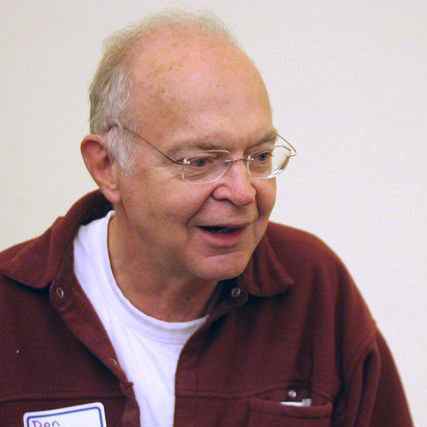
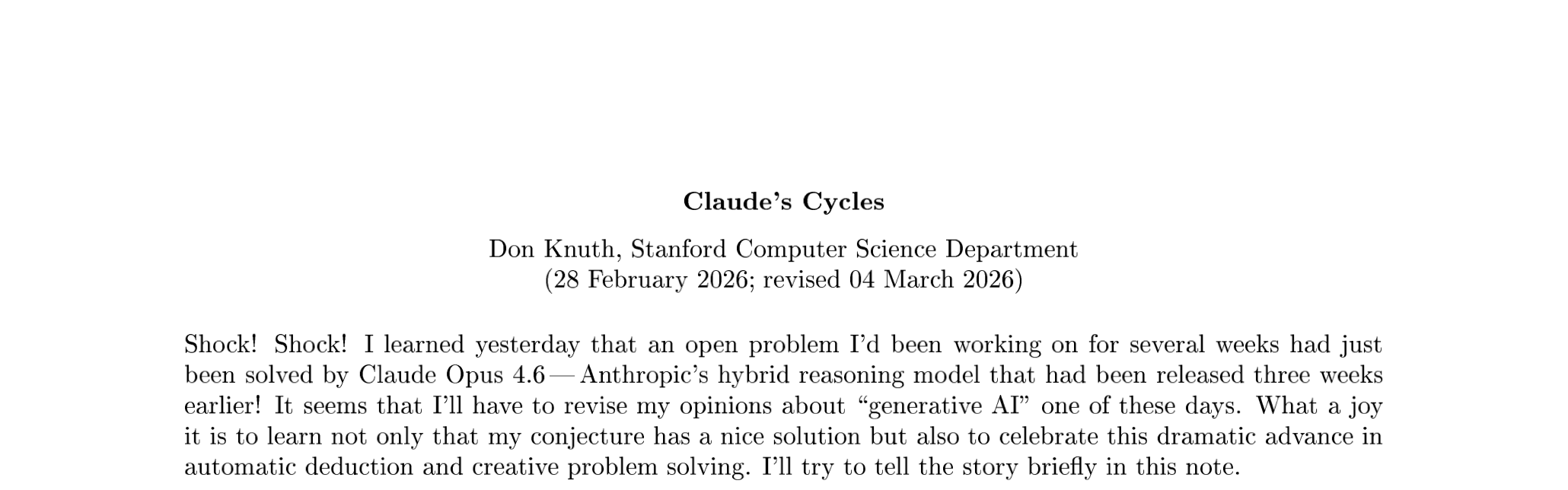
‘Shock! Shock!’ – with these words, Donald Knuth, Turing Award winner, creator of TeX and author of ‹The Art of Computer Programming›, opens his latest paper.
But what shocked him so much? Knuth had been working unsuccessfully for weeks on an open, complex problem in graph theory for The Art of Computer Programming. It was only when Claude Opus 4.6 from Anthropic came into play that the problem could be solved – in just one hour.
Based on this result, he wrote the formal mathematical proof and, in generalising it, found that there are exactly 760 ‘Claude-like’ decompositions, but none more beautiful than the one found by Claude. Knuth described Claude’s plan as ‘quite admirable’ and the result as ‘a dramatic advance in automatic deduction and creative problem solving’. He then promptly named the resulting paper Claude’s Cycles.
In April 2023, Knuth gave ChatGPT a 20-question exam in which he observed how it hallucinated the chapter structure of a Leon Uris novel. He concluded that this was ‘studying the task of how to fake it’
And this time, too, the session had to be restarted after random errors, and Claude.ai had to be repeatedly reminded to document its progress. Claude.ai also tried to take a different path from the solution it had already found, ‘seemed to get stuck’ and was ultimately unable to execute its own programme correctly. Nevertheless, generative AI has now reached a very high level, prompting Knuth to reconsider his view. In the foreword to his paper, he writes:
It seems that I’ll have to revise my opinions about ‘generative Al’ one of these days.
At the end of the paper, he goes even further and draws an awe-inspiring conclusion:
I think Claude Shannon’s spirit is probably proud to know that his name is now being associated with such advances. Hats off to Claude!
Claude Shannon is considered the father of information theory and is also the namesake of Claude.ai.
If Knuth now recognises that machines can solve problems at this high level, this is certainly also an indication that we are on the threshold of a new era in which intellectual insights are no longer reserved for humans alone. This points to a paradigm shift that will have an enormous impact on education and science, business and politics – and ultimately on our self-image.